
Scripture includes important references to Persia and related regions, showing that God rules over kings, empires, and generations. This teaching traces key passages in their biblical context and then considers prophecy with humility and pastoral care—seeking clarity and faithfulness rather than speculation.
In Scripture, Persia refers specifically to the kingdom that succeeded Babylon in the sixth century B.C. Biblically, it appears not as a distant ethnographic note, but as a major world empire directly involved in Israel's post-exilic history.
The Table of Nations in Genesis 10 records the descendants of Noah, including Elam (Genesis 10:22). Elam was an ancient region east of Mesopotamia. While Elam and Persia are not identical political entities in every period, the territories overlap geographically and later appear within the broader sphere of Persian rule.
By the sixth century B.C., Persia emerged as a dominant power under Cyrus the Great. The biblical text explicitly names Cyrus as the king of Persia who conquered Babylon and permitted the Jewish exiles to return to Jerusalem (Isaiah 44:28; Ezra 1:1–2). Thus, Persia enters the biblical record not merely as a geopolitical force, but as an instrument in God's covenantal purposes.
The Medes and Persians are often mentioned together (Daniel 5:28; Daniel 8:20), reflecting a united kingdom commonly referred to as the Medo-Persian Empire. This empire succeeded Babylon and became the ruling authority during the time of Daniel, Esther, Ezra, and Nehemiah.
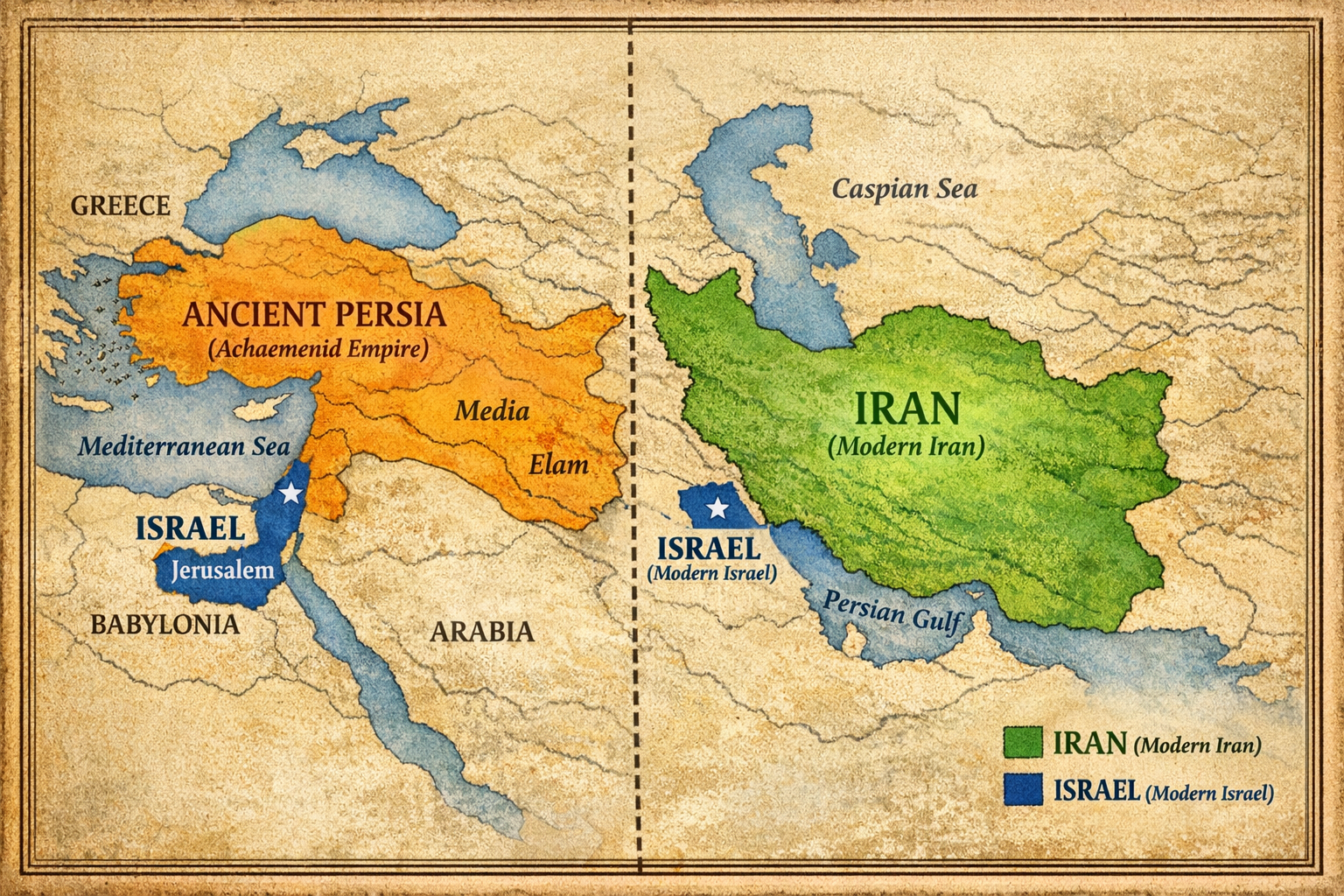
The name "Iran" is a much later historical development. While the biblical text consistently uses "Persia," the modern nation of Iran occupies much of the same geographic territory that was once central to the Persian Empire. Understanding this continuity helps readers distinguish between ancient biblical references and modern political realities.
Historically, the people of the region have long used forms of the word "Iran" internally, derived from an ancient term meaning "land of the Aryans" (in the historical Indo-Iranian sense, not the modern racial misuse of the word). However, the country was widely known in the Western world as "Persia" until 1935, when Reza Shah formally requested that foreign governments use the name "Iran" in diplomatic correspondence. In 1959, the government clarified that both "Iran" and "Persia" were acceptable internationally, though "Iran" remained the official state name. Understanding this historical naming shift helps modern readers avoid assuming that the biblical term "Persia" refers to a different geographic region than present-day Iran.
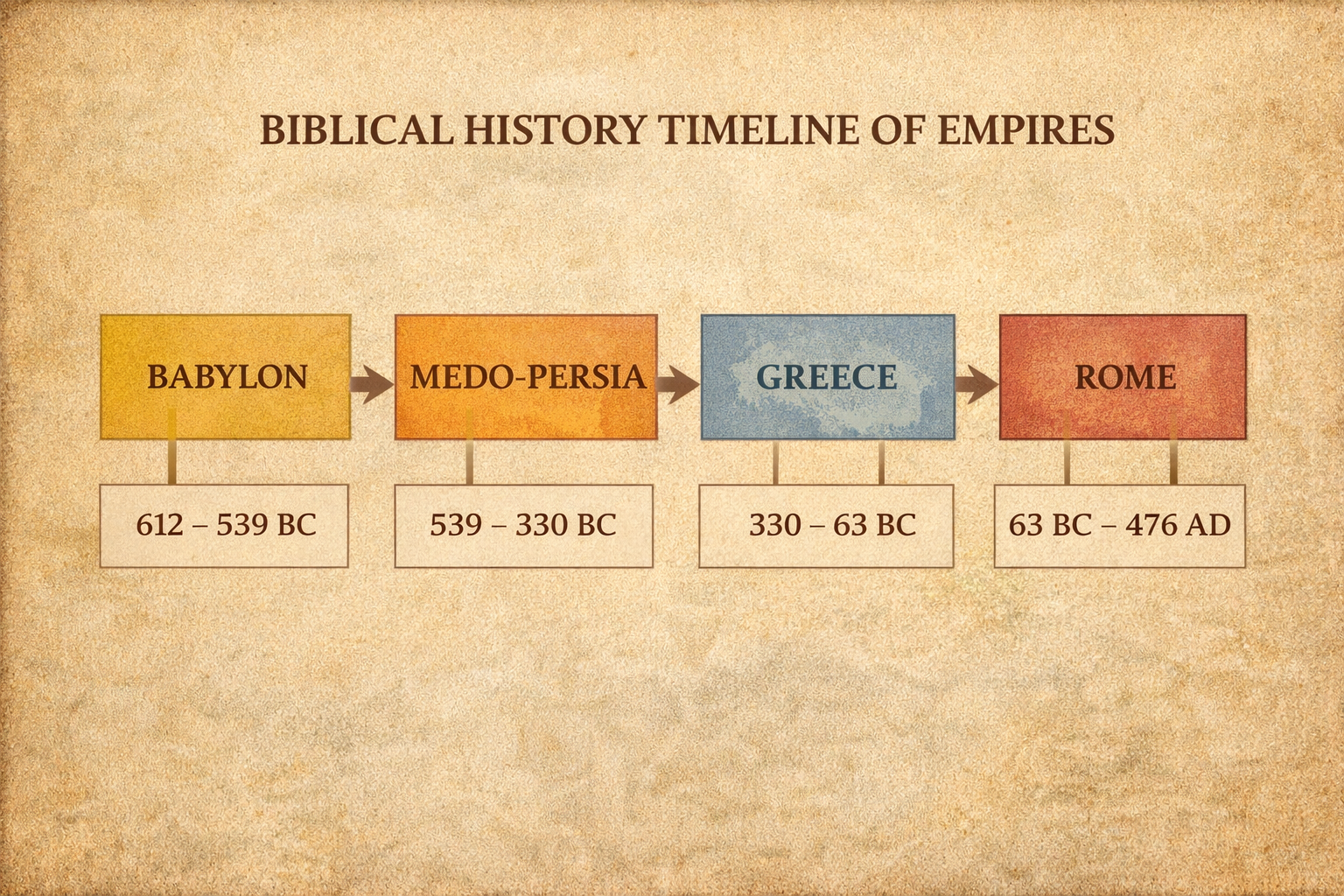
The rise of Persia is directly connected to God's redemptive purposes for His people. Through Isaiah, the Lord named Cyrus in advance as the ruler who would serve His plan (Isaiah 44:28; Isaiah 45:1). Later, this was fulfilled when Cyrus issued a decree allowing the exiles to return and rebuild the house of the Lord (Ezra 1:1–4).
These passages show that God can use even pagan rulers to accomplish covenant purposes. Persia is therefore woven into the redemptive storyline of Scripture, demonstrating that the Lord directs the course of empires according to His covenant purposes.
Daniel describes the Medo-Persian kingdom within prophetic visions of successive world powers. In Daniel 8, the ram with two horns represents Media and Persia (Daniel 8:20), emphasizing that kingdoms rise and fall under God's authority.
Daniel 10–11 also includes the "prince of Persia" in a spiritual conflict context (Daniel 10:13, Daniel 10:20). The text reveals a heavenly dimension behind earthly events, while still calling God's people to prayer, humility, and trust in the Lord who reveals what is to come.
With the historical foundation in place, we now consider related regions mentioned in Scripture and then move carefully into prophetic passages where Persia is named.
The biblical record also speaks of Elam, an ancient Near Eastern region east of Mesopotamia that later fell within the territorial reach of the Persian Empire. Jeremiah records judgments involving Elam (Jeremiah 49:34–39), yet even there God speaks of future restoration.
In the New Testament, Elamites are present at Pentecost and hear the mighty works of God (Acts 2:9–11). This reminds us that the gospel reaches across ethnic and geographic boundaries, including peoples linked to ancient Persian territories.
Christians should distinguish carefully between ancient Persia in Scripture and the modern nation-state of Iran. Some historical continuity exists in geography and heritage, but direct one-to-one prophetic claims require textual caution. Not every current event can be assigned to a specific verse.
Faithful interpretation begins with context, authorial intent, and canonical balance (2 Timothy 2:15). We should resist sensational readings and instead let Scripture interpret Scripture with humility.
The map below is a visual aid to help orient the reader geographically. It compares the broad footprint of ancient Persia (as a general biblical-times reference) with modern Iran, and shows Israel in relation to both.
With the geographic setting in view, we now turn to the primary prophetic passage in which Persia is named in connection with a future conflict involving Israel.
The most direct prophetic reference connecting Persia with a future conflict involving Israel appears in Ezekiel 38–39. In that passage, "Persia" is listed among a coalition of nations that come against Israel in what is described as a latter-days confrontation (Ezekiel 38:5, Ezekiel 38:8, Ezekiel 38:16). The text portrays a large confederation led by "Gog" that advances against Israel, only to be decisively stopped by divine intervention.
Several important observations must guide interpretation. First, Ezekiel is writing in a specific prophetic genre that includes symbolic and apocalyptic elements. Second, the coalition described includes multiple nations, not Persia alone. Third, the scale and outcome of the conflict in Ezekiel involve unmistakable divine judgment that goes beyond ordinary military developments.
Because of these factors, Christians should exercise caution when identifying any specific modern war as the definitive fulfillment of Ezekiel 38–39. While modern Iran geographically overlaps with ancient Persia, Scripture does not provide a simple one-to-one equation between every contemporary military action and a specific prophetic verse.
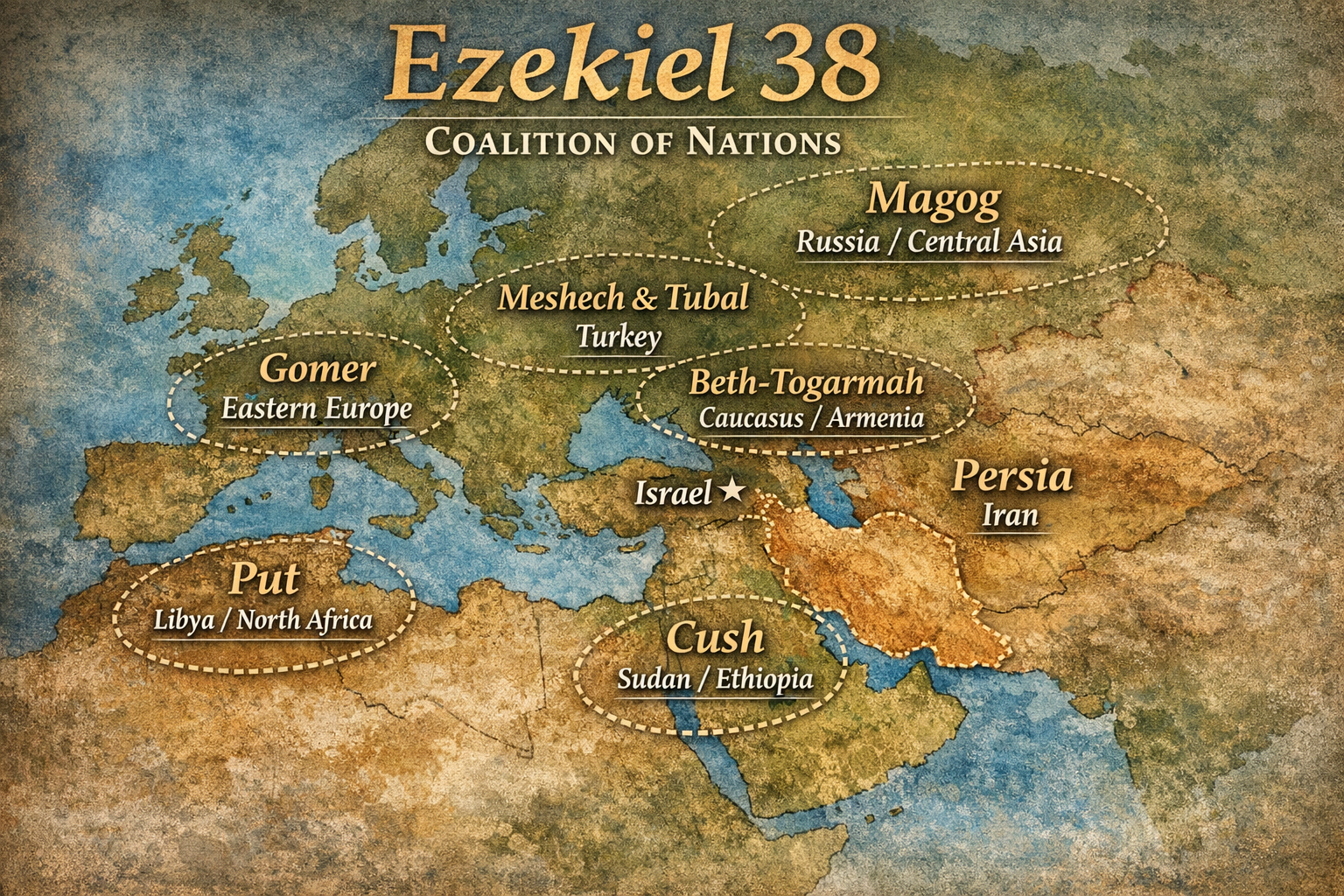
Ezekiel provides specific names for the coalition that comes against Israel. The passage identifies "Gog, of the land of Magog, the chief prince of Meshech and Tubal" (Ezekiel 38:2–3), along with additional nations including Persia, Cush, Put, Gomer, and Beth-togarmah (Ezekiel 38:5–6).
These names reflect the geopolitical world known to Ezekiel in the sixth century B.C. Many scholars attempt to correlate these ancient designations with identifiable historical regions. While exact modern equivalents cannot be stated with absolute certainty, the following historical associations are commonly proposed in biblical scholarship:
It is important to emphasize that these identifications are based on historical geography and linguistic study rather than explicit biblical reinterpretation of modern nation-states. Scripture itself names ancient peoples; modern parallels are inferential and should be held with humility.
The consistent feature of the passage is not merely the identity of each nation, but the fact that a multinational coalition gathers against Israel and is ultimately overthrown by the direct intervention of the Lord (Ezekiel 38:18–23). The theological emphasis rests on God's sovereignty and the public vindication of His holiness before the nations.
The following map provides a visual representation of the coalition described in Ezekiel 38, overlaying the biblical names with commonly proposed modern geographic correlations. These identifications reflect historical scholarship and are presented for educational purposes.
In the modern world, tensions and armed conflict between Iran and Israel have escalated in recent years, including direct exchanges and broader regional involvement. These developments naturally lead many believers to revisit passages such as Ezekiel 38–39, Daniel 10, and Zechariah 12.
It is reasonable to observe that Scripture anticipates hostility surrounding Israel in the latter days (Zechariah 12:2–3) and that nations will continue to rage under God’s sovereign authority (Psalm 2:1–6). However, Jesus also warned that wars and rumors of wars, by themselves, are not definitive proof that the end has arrived (Matthew 24:6).
Therefore, while present conflicts between Iran and Israel may align in a general way with the prophetic expectation that Israel will face opposition, we must avoid declaring that any specific modern military campaign is the final, climactic fulfillment unless the biblical markers clearly match the prophetic text.
Sound interpretation requires humility, careful exegesis, and a refusal to move beyond what Scripture explicitly states (2 Timothy 2:15). Our confidence rests not in predicting timelines, but in the certainty that God governs nations and that His redemptive plan in Christ will prevail.
In summary, Scripture presents Persia as a real historical empire used by God in Israel’s restoration, and it names Persia in a broader latter-days framework. Our calling is to interpret carefully, avoid overconfident claims, and respond with faith, prayer, and steadfast hope in Christ.
The biblical witness to Persia and related regions calls believers to confidence in God's governance of history. Kingdoms change, but the Word of God stands, and His redemptive plan in Christ will be fulfilled.